Bertilak’s Castle
Sir Gawain and the Green KnightBertilak’s Castle is the fortified forest residence where Sir Gawain is received during his journey to the Green Chapel. Set apart from the court and surrounded by a park and hunting country, it offers hospitality at the very moment his quest seems nearly spent; the castle’s lord promises help, while the estate’s hunts give the days there a second, parallel course of action. Its significance changes when the lord’s identity is disclosed: the castle is not merely a safe stopping place, but the home of the power behind the adventure’s apparent marvels.
Setting and Approach
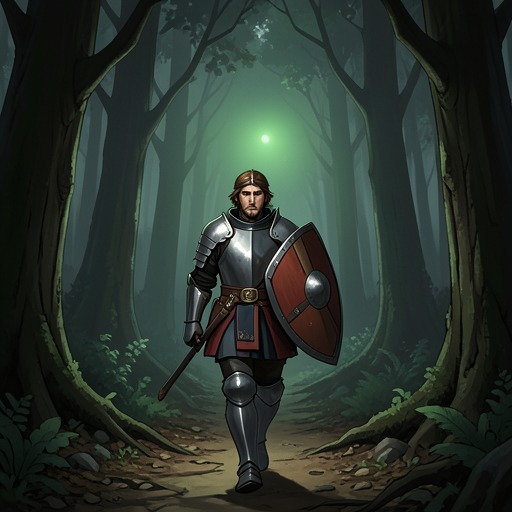
After riding through a deep, wild forest, with high hills on either side and woodland below, Sir Gawain comes upon the castle on a rise above a clearing. The approach makes it appear as an extraordinary sight within the wilderness. Its enclosing park and closely built, pointed palace mark it as a protected residence, distinct from the exposed country through which the knight has been travelling. The description establishes the contrast that governs his arrival: the forest is difficult and uncertain, while the castle promises order, shelter, and a place among people.
The castle also belongs to the romance’s larger movement from Arthur’s court into an unfamiliar world. The poem presents its adventure as a marvel arising from the wonders of King Arthur’s time; Sir Gawain’s solitary ride carries that courtly expectation into a setting where hospitality and danger occupy the same ground. The castle is an impressive destination in its own right, but its position in the narrative makes it a threshold: the traveller who enters seeking rest is also entering the next stage of his trial.
Welcome and Refuge
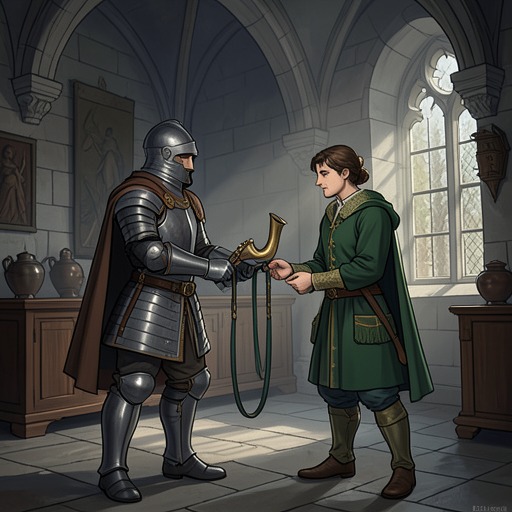
Within the castle, a bright fire burns in the hall. Its lord comes down from his chamber to meet Sir Gawain on the floor and welcomes him, offering him the freedom to stay as he pleases. The greeting is a concrete reversal of the knight’s isolation on the road. A man who has been riding alone is met with ceremony and comfort, and the castle’s household makes room for him before demanding an account of his purpose.
The lord asks what grave undertaking drove Sir Gawain from the king’s court to travel alone. Sir Gawain explains that he has only three days left and is as ready to die as to fail his errand. The host answers with laughter rather than alarm. He tells the knight to remain, promising to show him how to reach his destination by the appointed time and assuring him that the Green Chapel need trouble him no longer. The offer makes the castle a refuge from immediate hardship, but it also places the host in control of the route and timetable on which the quest depends.
The Estate and Its Hunts
The grounds beyond the residence extend the castle’s action into the surrounding country. At daybreak, the hunters mount their horses, release the hounds from the kennel, and sound their horns. The lord spends his time in the woods and heath hunting deer; the account follows the hunt through the gathering of the dead animals and the careful work of preparing them. The estate is therefore not just a backdrop for the welcome indoors: it is an active domain, organized around the lord’s hunting parties and their procedures.
The fox hunt continues this pattern of movement across the land. The hunters call out when a quarry is found at the edge of a marshy place, urge on the hounds, and pursue the fox as it runs. Later, the lord is still leading his hunt across the clearing after following the animal for a long time; it springs across a ditch as he tries to catch sight of it. Such details give the estate a changing daily life beyond the hall. The castle anchors an outward-moving sequence of pursuit, while its surrounding woods, heath, marsh, clearing, and ditch supply the shifting terrain of the chase.
Identity and Narrative Significance
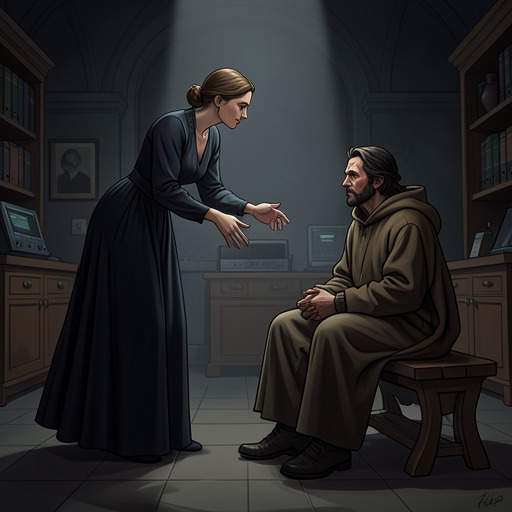
The castle’s final importance lies in what its hospitality conceals. When asked to give his true name, the speaker identifies himself as Bertilak of Hautdesert and says that Morgan le Fay lives in his house. He attributes the events to her power and to learned craft. The disclosure connects the forest residence to the marvelous adventure that first drew the poem away from the court: the host is not simply a generous lord encountered by chance, and his home is bound to the forces shaping the quest.
That recognition recasts the castle without cancelling its material features. The hall, fire, park, chamber, and hunting country have all been presented as ordinary signs of a lordly household, yet the revelation gives the welcome and the estate’s ordered activity a place within a designed test. The castle’s two functions remain in tension: it shelters Sir Gawain and helps him continue toward the Green Chapel, while also serving as the setting from which the hidden design of his adventure becomes legible. In this way, the romance turns an impressive refuge into a point of disclosure, joining the rituals of hospitality and the pursuits of the hunt to the larger problem of how appearances conceal the truth.